Kellie's Castle (sometimes also called Kellie's Folly ) is located near Batu Gajah , and is about 20 minutes' drive from Ipoh , Perak , Malaysia . The unfinished, ruined mansion, was built by a Scottish planter named William Kellie Smith . According to differing accounts, it was either a gift for his wife or a home for his son. Kellie's Castle is situated beside the Great River (Sungai Raya) which joins to the Kinta River.
Travelling the world through postcards... Stamped postcards I received from postcrossing and direct swapping!
Showing posts with label castles. Show all posts
Monday, August 3, 2015
Saturday, August 1, 2015
Castles in Coburg, Germany
![]() |
| DE-695621 |
Monday, April 27, 2015
Pielisjoki Castle, Joensuu, Finland
![]() |
| FI-1597839 |
Sunday, April 5, 2015
Trebon, Czech Republic
Třeboň is a historical town in South Bohemian Region of Czech Republic. Třeboň was established around the middle of the 12th century. In 1366, the House of Rožmberk/Rosenberg became owner of the estate. The period of greatest growth for the town dates to the second half of the 15th century when Petr IV of Rožmberk (1462–1523) seriously began to take care of the land. The district became famous as a fish pond farming area. From 1611 the Houses of Habsburg and Schwarzenbergwere owners of the town and the estate.
Buchlov Castle, Hrad, Czech Republic
![]() |
| CZ-125433 |
Tuesday, March 17, 2015
Mir Castle, Belarus
The Mir Castle complex (Mirsky zamok) is an outstanding example of 16th-century fortification art. It’s located in the town of Mir in the Grodno region of Belarus.
The construction of this Belarus’ Gothic stylecastle was started in the 1520s by Duke Ilinich.
In 1568 the castle came into the hands of Mikolay Radziwil, who completed it in Renaissance style.
A three-storey palace was built along the eastern and northern walls of the castle which had forty fretted rooms. Earth walls were built around the castle with bastions at the corners, surrounded by a water moat.
An Italian garden was laid to the north of the walls and an artificial lake was established to the south. The Radziwills owned the castle for several centuries.
During the Napoleonic wars the castle was severely damaged.
In 1891, the castle is bought by Nikolai Svyatopolk-Mirsky who started bringing order to his new property. His son continued his father’s work, led by renowned architectTeodor Bursze.
A subsidiary of the National Art Museum of the Republic of Belarus was located in the castle in 1992.
Nesviazh Castle, Belarus
Nesvizh Castle or Niasvizh Castle is a residential castle of the Radziwiłł family in Nesvizh, Belarus. It is situated at an elevation of 183 meters.
Prior to 1939 the complex was located in Poland and was considered one of the most beautiful Polish castles in the Kresyregion.
Castle of Mir, Belarus
Kreva Castle, Belarus
Kreva Castle is the ruins of a major fortified residence of the Grand Dukes of Lithuania (Gediminas and Algirdas) in the village of Kreva, Belarus. Algirdas's brother Kęstutis was imprisoned and murdered in the Kreva Castle in 1382. Kreva Castle is situated at an elevation of 220 m. The Union of Krewo (Act of Krewo), the first step towards the Polish–Lithuanian Commonwealth, was signed in the castle three years later. The castle was sacked by the Crimean Tatars in the early 16th century and stood unoccupied for a long time. By the 19th century, much of the walls had crumbled away. The World War I dealt a final blow to the decaying structure, since the castle stood on the front line between Russian and German armed forces. In 19th and 20th centuries, the ruins were partially conserved, particularly by Poland in 1929. However, the monument crumbles further.
Castle of Mir, Belarus
The Mirsky Castle Complex is a UNESCO World Heritage site in Belarus. It is located in the town of Mir, in the Karelichy District of the Hrodna voblast, at 53°27′4.46″N 26°28′22.80″E, 29 km to the north-west from another World Heritage site, Nesvizh Castle. Mir Castle Complex is situated at an elevation of 164 meters.
Prior to 1939 the castle was located in Poland.
Monday, March 2, 2015
Castelvecchio, Verona, Italy
The castle is powerful and compact in its size with very little decoration - one square compound built in red bricks, one of the most prominent examples of Gothic architecture of the age, with imposing M-shaped merlons running along the castle and bridge walls. It has seven towers, a superelevated keep (maschio) with four main buildings inside. The castle is surrounded by a ditch, now dry, which was once filled with waters from the nearby Adige.
Castelvecchio is now home to the Castelvecchio Museum and the local officer's club which can be accessed through the left door on Corso Cavour.
Wednesday, February 25, 2015
Robert the Bruce Monument in Edinburgh Castle, Scotland, UK
Robert I (11 July 1274 – 7 June 1329), popularly known as Robert the Bruce (Medieval Gaelic: Roibert a Briuis; modern Scottish Gaelic: Raibeart Bruis; Norman French: Robert de Brus or Robert de Bruys, Early Scots: Robert Brus), was King of Scots from 1306 until his death in 1329. Robert was one of the most famous warriors of his generation, and eventually led Scotland during the Wars of Scottish Independence against England. He fought successfully during his reign to regain Scotland's place as an independent nation and is today remembered in Scotland as a national hero.
Edinburgh Castle is a historic fortress which dominates the skyline of the city of Edinburgh, Scotland from its position on the Castle Rock. Archaeologists have established human occupation of the rock since at least the Iron Age (2nd century AD), although the nature of the early settlement is unclear. There has been a royal castle on the rock since at least the reign of David I in the 12th century, and the site continued to be a royal residence until the Union of the Crowns in 1603. From the 15th century the castle's residential role declined, and by the 17th century it was principally used as military barracks with a large garrison. Its importance as a part of Scotland's national heritage was recognised increasingly from the early 19th century onwards, and various restoration programmes have been carried out over the past century and a half. As one of the most important strongholds in the Kingdom of Scotland, Edinburgh Castle was involved in many historical conflicts from the Wars of Scottish Independence in the 14th century to the Jacobite Rising of 1745. It has been besieged, both successfully and unsuccessfully, on several occasions.
Edinburgh, the country's capital and second-largest city, was the hub of the Scottish Enlightenment of the 18th century, which transformed Scotland into one of the commercial, intellectual, and industrial powerhouses of Europe. Glasgow, Scotland's largest city, was once one of the world's leading industrial cities and now lies at the centre of the Greater Glasgow conurbation. Scottish waters consist of a large sector of the North Atlantic and the North Sea, containing the largest oil reserves in the European Union. This has given Aberdeen, the third-largest city in Scotland, the title of Europe's oil capital.
Sunday, February 22, 2015
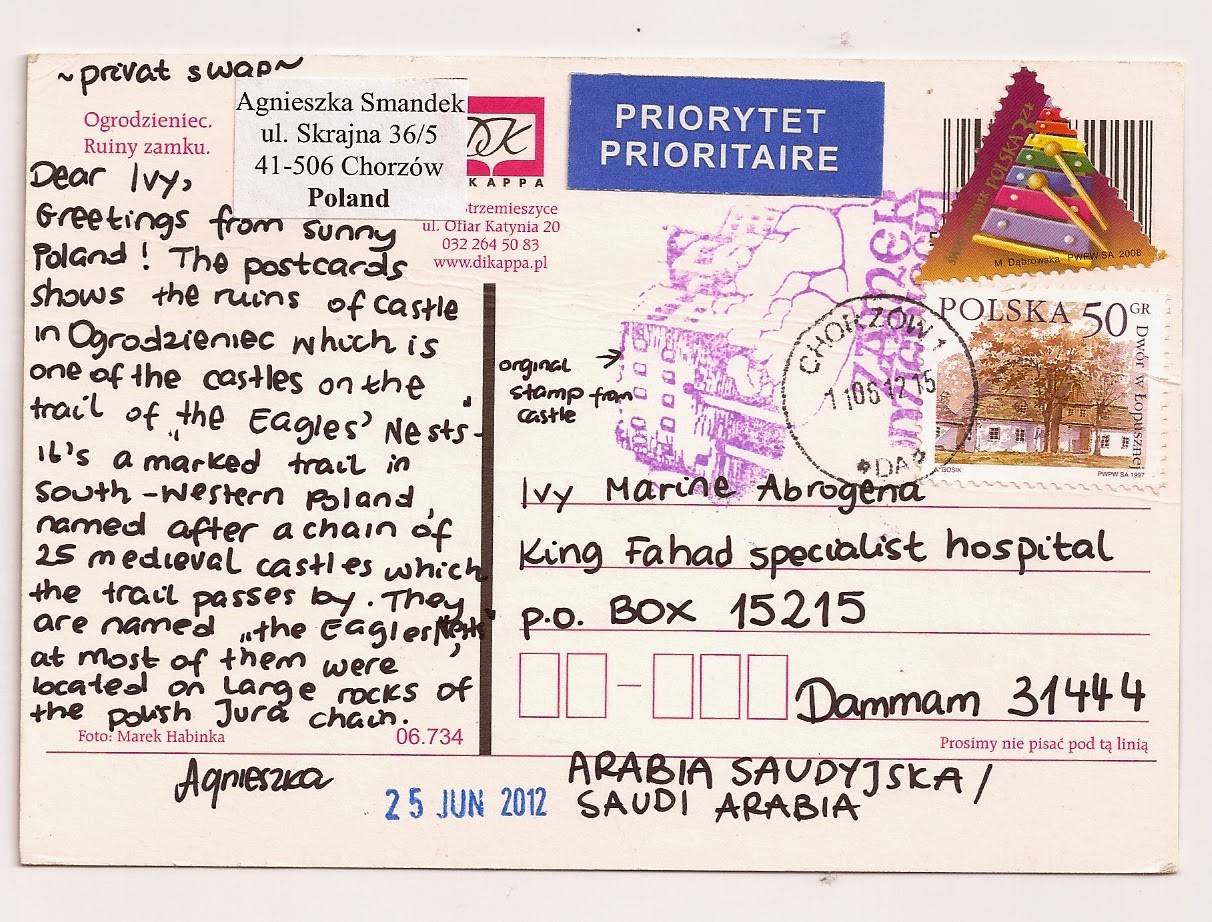
Ogrodzieniec castle, Poland
Ogrodzieniec Castle – ruins of the medieval castle in the Kraków-Częstochowa Upland. Rebuilt several times in its history, the castle was originally built in the 14th–15th century by the Włodkowie Sulimczycy family. The castle is situated on the 515.5 m high Castle Mountain (Polish: Góra Zamkowa), the highest hill of the Kraków-Częstochowa Upland. Located on the Trail of the Eagles' Nests, the ruins are opened for visitors.
Saturday, February 21, 2015
Beaufort Castle, Luxembourg
Beaufort Castle (French: Château de Beaufort) dating from the 11th century consists of the ruins of the medieval fortress and an adjacent Renaissance château. It is located in Beaufort in eastern Luxembourg. It was probably in the 11th century that the castle began as a small square-shaped fortress on a large rock protected by a moat and a second wall above the valley. A reference from 1192 indicates that Wauthtier de Wiltz et Beaufort was its first lord. During the first half of the 12th century, a keep was added and the gate was moved and enlarged. In 1348, the property came into the hands of the House of Orley after Adelaide of Beaufort married William of Orley. The Lords of Orley made significant extensions overlooking the valley. In 1477, Maximilian of Austria transferred the castle to Johann Bayer von Boppard after Johann von Orley-Beaufort committed a breach in trust. In 1539, Bernard von Velbrück became Lord of Beaufort through marriage and added the large Renaissance wing with cross-framed windows on top of the medieval walls.
Furstentum, Liechtenstein
The Principality of Liechtenstein was established within the Holy Roman Empire in 1719; it became a sovereign state in 1806. Until the end of World War I, it was closely tied to Austria, but the economic devastation caused by that conflict forced Liechtenstein to conclude a customs and monetary union with Switzerland. Since World War II (in which Liechtenstein remained neutral) the country's low taxes have spurred outstanding economic growth. However, shortcomings in banking regulatory oversight have resulted in concerns about the use of the financial institutions for money laundering.
Vaduz Castle, Liechtenstein
Vaduz Castle is the palace and official residence of the Prince of Liechtenstein. The castle gave its name to the town of Vaduz, the capital of Liechtenstein, which it overlooks from an adjacent hilltop. The Princely Family of Liechtenstein acquired Vaduz Castle in 1712 when it purchased the countship of Vaduz. At this time,Charles VI, Holy Roman Emperor, combined the countship with the Lordship of Schellenberg, purchased by the Liechtensteins in 1699, to form the present Principality of Liechtenstein.[7] During the medieval days of the principality, the prince could have sought refuge in the castle from a potential peasant uprising.
Osaka Castle, Japan
Osaka Castle is a Japanese castle in Chūō-ku, Osaka, Japan. The castle is one of Japan's most famous and it played a major role in the unification of Japan during the sixteenth century of the Azuchi-Momoyama period. The main tower of Osaka Castle is situated on a plot of land roughly one square kilometer. It is built on two raised platforms of landfill supported by sheer walls of cut rock, using a technique called Burdock piling, each overlooking amoat. The central castle building is five stories on the outside and eight stories on the inside, and built atop a tall stone foundation to protect its occupants from attackers.
The castle grounds, which cover approximately 60,000 square meters (15 acres), contain thirteen structures that have been designated as important cultural assets by the Japanese government.
Saint Fargeau Castle, France
Saint-Fargeau is a commune in the Yonne department in Burgundy in north-central France.
- In the early years of the reign of Louis XIV, the château was the home to his exiled cousin, the wealthy Anne Marie Louise d'Orléans.[1] She lived in the château of the town, giving the building its present appearance. The building also has her monogram over its main entrance. She held the title of duchesse de Saint-Fargeau in her own right.
- Jean d'Ormesson - a French novelist, mostly writing partially or totally autobiographic novels. He was brought up at the château and was born in 1925.
- Robert Gall 1918 - 1990 - was a French lyricist.
Subscribe to:
Posts (Atom)